Early registration had a speed standard: to be registered, a horse had to trot or pace a mile within 2 minutes 30 seconds. That standard gave the breed its name. Today many Standardbreds pace a mile in under 1:50, and trotters are only a few seconds slower.
A trotter moves its diagonal legs together: left front with right hind. A pacer moves both legs on the same side together. Most horses race at one gait or the other, and the bloodlines differ slightly.
Almost every modern Standardbred traces back to Hambletonian 10, foaled on 5 May 1849 in Sugar Loaf, Orange County, New York, a short drive from our barns. He is buried in Chester, NY. The Hambletonian, the best-known race for trotters, is named after him.
The US Trotting Association (USTA) keeps the breed registry. Most Standardbreds are bay, brown or black and weigh roughly 800 to 1,000 lb. They are known as calm, willing horses, which is why many go on to riding and driving careers after racing.
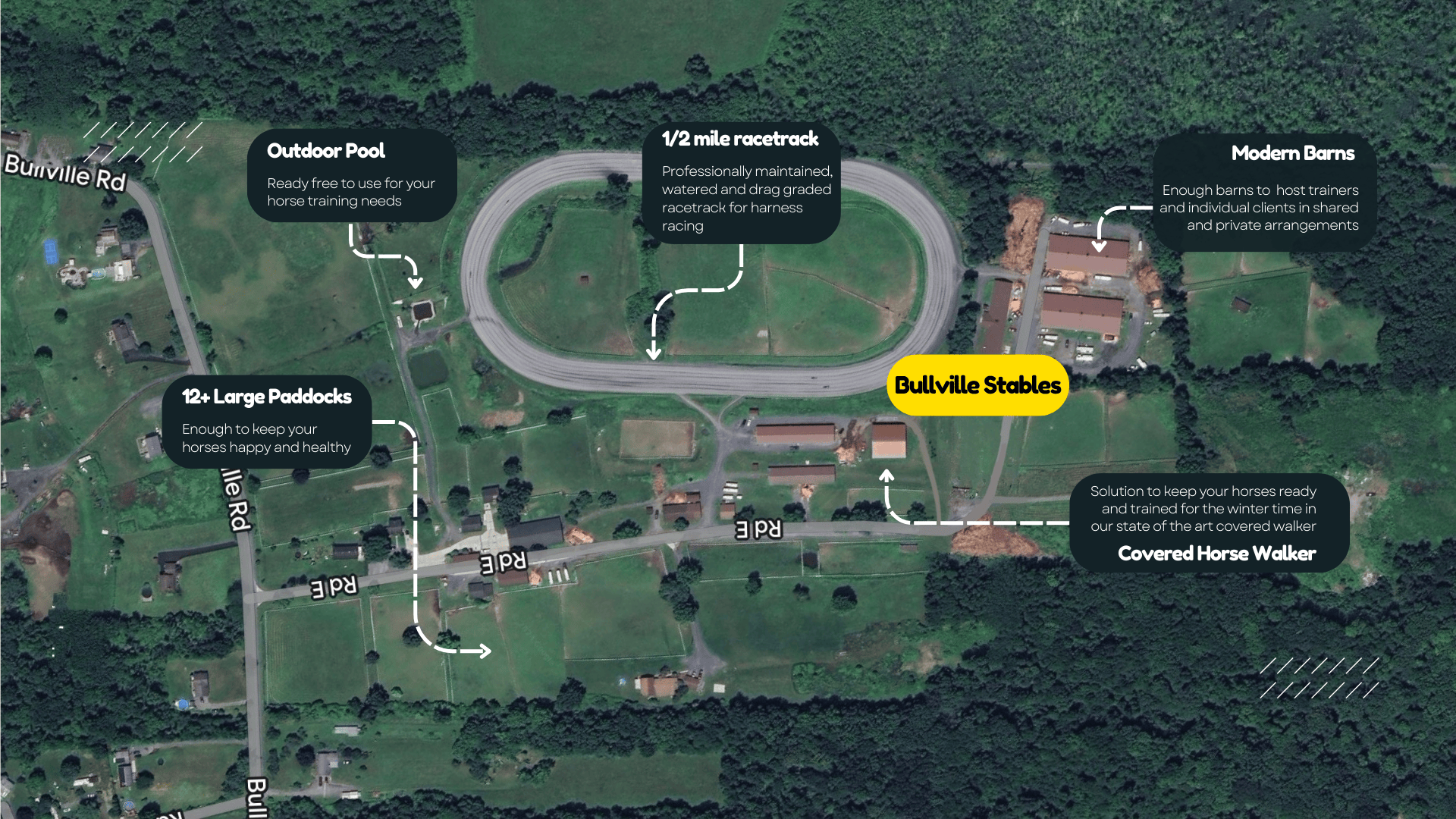
At Bullville Stables we only stable Standardbreds: 250+ stalls in 9 barns and a half-mile track open all year.
No. Thoroughbreds race under saddle at a gallop. Standardbreds race in harness at a trot or pace. The breeds share early ancestry through the stallion Messenger but have separate registries.
Yes. Many retired Standardbreds become riding horses after retraining.
The United States. Its foundation sire, Hambletonian 10, was born in Orange County, New York in 1849.
Harness Racing Guide · How harness racing works · Standardbred training center
Sources: USTA; Wikipedia (Standardbred, Hambletonian 10); Britannica (harness racing); Oklahoma State University, Breeds of Livestock.